
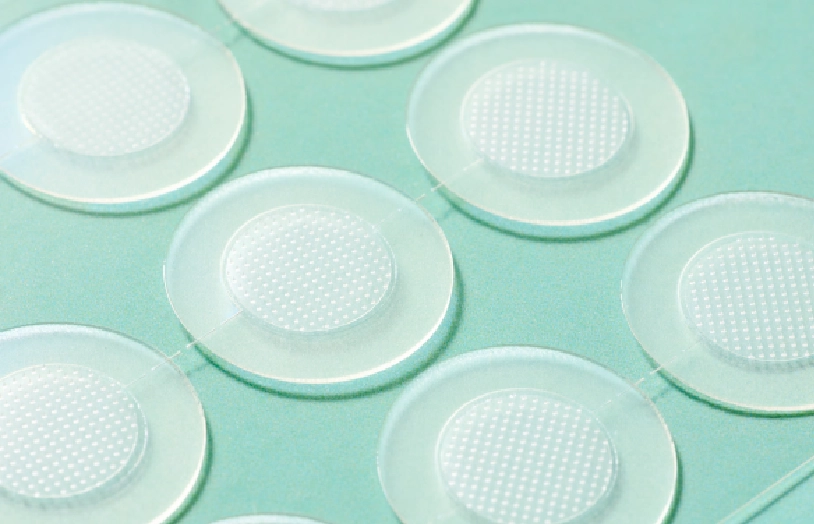
What is microneedling technology ?
Microneedling technology uses tiny needles. These microneedles can vary in length, shape, and properties depending on the desired application. They can penetrate the epidermis without damaging it or reaching sensitive areas.
Developed in the 2000s, this technology has since benefited from numerous advancements. For example, it is already used:
- in general medicine, for the transdermal administration of insulin in people with diabetes;
- in dermatology, to aid wound healing, skin repair, and scar reduction;
- in aesthetics and dermocosmetics, to stimulate collagen production and skin regeneration, improve skin texture and appearance, and enhance the penetration of active ingredients.¹
Microneedling technology is also being studied by scientists worldwide as a new method for delivering medications and vaccines.<sup>1,2</sup>
For skincare, microneedling needles are very fine, only a few hundred micrometers long, and do not penetrate the dermis deeply. This is why this technology is considered "non-invasive."
What is a microneedling patch ?
A microneedling patch is like a small "bandage" that adheres to the skin. The side of the patch that comes into contact with the skin is equipped with microneedles that penetrate the epidermis. Depending on the desired effect, the microneedles can remain in place or dissolve on their own after application, delivering active ingredients in a controlled manner to a precise area.²‧³
The patch format allows users to benefit from microneedling technology independently and at home.
What are the advantages of microneedling technology for skincare?
The main advantages of this technology are:
- Simplicity and ease of use: no technical procedures, no appointments at a salon;
- Gentle administration: the microneedles do not reach the skin's nerves;
- Targeted action: only the affected area is actively treated;
- Better absorption of the administered active ingredients;
- Reduced risk of infection thanks to the non-invasive nature of the needles and the protection of the treated area.
With these advantages, microneedling is emerging as a promising alternative to existing solutions and an innovative method for safer and more effective skin treatments.
What are the benefits of microneedling technology for treating a pimple?
- The microneedles penetrate to the heart of the pimple and facilitate the drainage of exudates (liquids and impurities). They deliver active ingredients that help dry out and treat blemishes.
- As they dissolve, the microneedles release a range of active ingredients selected to target imperfections from their earliest stages.
Results:
- The blemish is treated and protected locally;
- The improvement is visible and lasting;
- The skin appears more comfortable and balanced.
Discover on our website:
- The URGO Hydrocolloid Microneedling Patch to target and eliminate blemishes and imperfections as soon as they appear. Discreetly purifies, absorbs, and protects localized imperfections.
- Acne-prone skin: Hydrocolloid Technology (HDC) is a game changer.
- The complete URGO skincare range for acne-prone skin.
¹. Jaiswal S, Jawade S. Microneedling in Dermatology: A Comprehensive Review of Applications, Techniques, and Outcomes. Cureus. 2024 Sep 23;16(9):e70033
². Sartawi Z, Blackshields C, Faisal W. Dissolving microneedles: Applications and growing therapeutic potential. J Control Release. 2022 Aug;348:186-205
³. Nazary Abrbekoh F et al. Application of microneedle patches for drug delivery; doorstep to novel therapies. J Tissue Eng. 2022 Apr 29;13:20417314221085390
URGO Patch HDC micro-needling (micro-needles) is a cosmetic. Read the instructions before use. URGO Healthcare Laboratories - RCS DIJON 798 251 559 – Share capital €56,280,458.03/2026